You’re moving fast, responding to everything, trying to keep up—and still feeling like nothing is actually working. The meetings pile up, deadlines slip, and no matter how much effort you put in, it feels like constant motion without real progress.
That’s not a strategy problem. It’s a clarity problem.
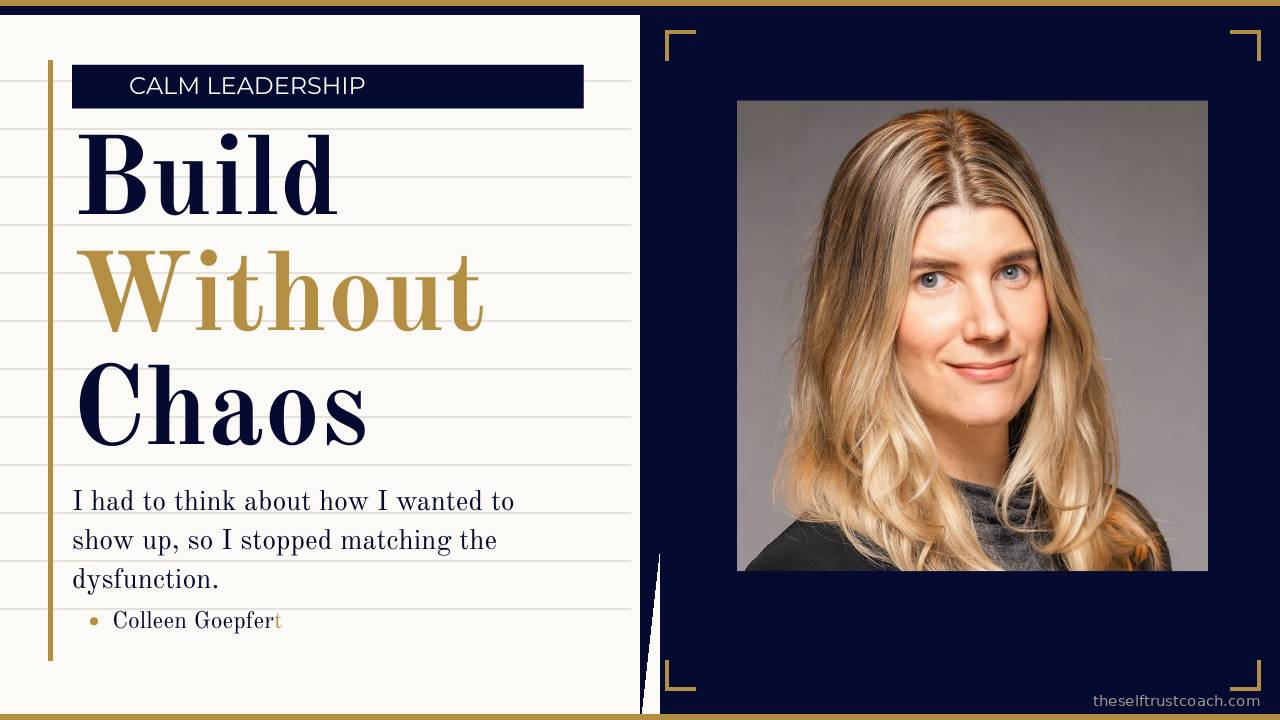
The core concept — Build Without Chaos
One of the most powerful shifts in this conversation is the distinction between reacting to chaos and leading through it.
Colleen describes how, for years, she operated in high-growth environments where speed and urgency were the norm. She thought leadership meant matching that pace. But underneath it all, she was reacting—second-guessing what she already knew and managing noise instead of leading from clarity.
The turning point wasn’t eliminating chaos. It was realizing that chaos isn’t the problem—it’s the invitation.
Her framework, Build Without Chaos, starts with decoding the chaos:
Where is energy being wasted?
Where is ownership unclear?
Where is misalignment happening?
From there, you move into designing the calm—creating structure, clarity, and a clear path forward.
What’s interesting is that most people stop at awareness. They see the chaos, talk about it, analyze it—but never design something different. And that’s why nothing changes.
Calm leadership isn’t passive. It’s intentional. It’s choosing clarity over urgency—even when urgency feels productive.
Why this matters for your business
When you lead from urgency, everything becomes reactive.
You move fast—but you redo decisions. You push harder—but results don’t stick. You create motion—but not momentum.
And over time, that creates burnout—not just for you, but for your entire team.
What Colleen highlights is this: you can scale output through pressure for a short period, but you can only scale trust through clarity.
Clarity creates:
Faster decision-making (because you’re not re-deciding)
Stronger team alignment (because people understand the why)
Sustainable results (because they’re built with structure, not stress)
And most importantly—it changes how you show up.
You stop chasing alignment externally and start leading from it internally.
What to do with this
If you’re in a chaotic environment—or just feeling like everything is “a lot”—you don’t need to fix everything at once.
Start here:
Dig at your feet Instead of trying to solve everything, ask: what can I impact right now, with what’s in front of me?
Pause before you decide Urgency will tell you to move quickly. Clarity will tell you to understand the ask first. Choose clarity.
Identify what you’re over-owning vs under-owning Where are you taking responsibility for things that aren’t yours? Where are you avoiding what is?
Listen to what keeps coming up What’s the recurring frustration from your team (or yourself)? That’s your entry point.
Choose transparency over control When people understand what’s happening, they move faster—not slower.
Watch the full episode here: https://youtu.be/ju_dm73iOQw
You don’t need to move faster to get better results. You need to move with clarity.
Dawn Ledet (Luh-Day — yes, it's French) is a business coach, author, speaker, and podcaster, where she helps coaches and experts grow their businesses by strengthening the leader behind the strategy. She specializes in helping high-capacity entrepreneurs claim agency, make powerful decisions, follow through and let data inform the how, never the who or the whether.
The first question she asks is Where Are You Standing? Because when you know where you're standing, you know where to work.
7 Day Self Trust Boost Challenge
Get instant access to jumpstart your self trust in just 7 days direct to your inbox.
🔒Privacy Policy: We hate SPAM and promise to keep your email address safe.