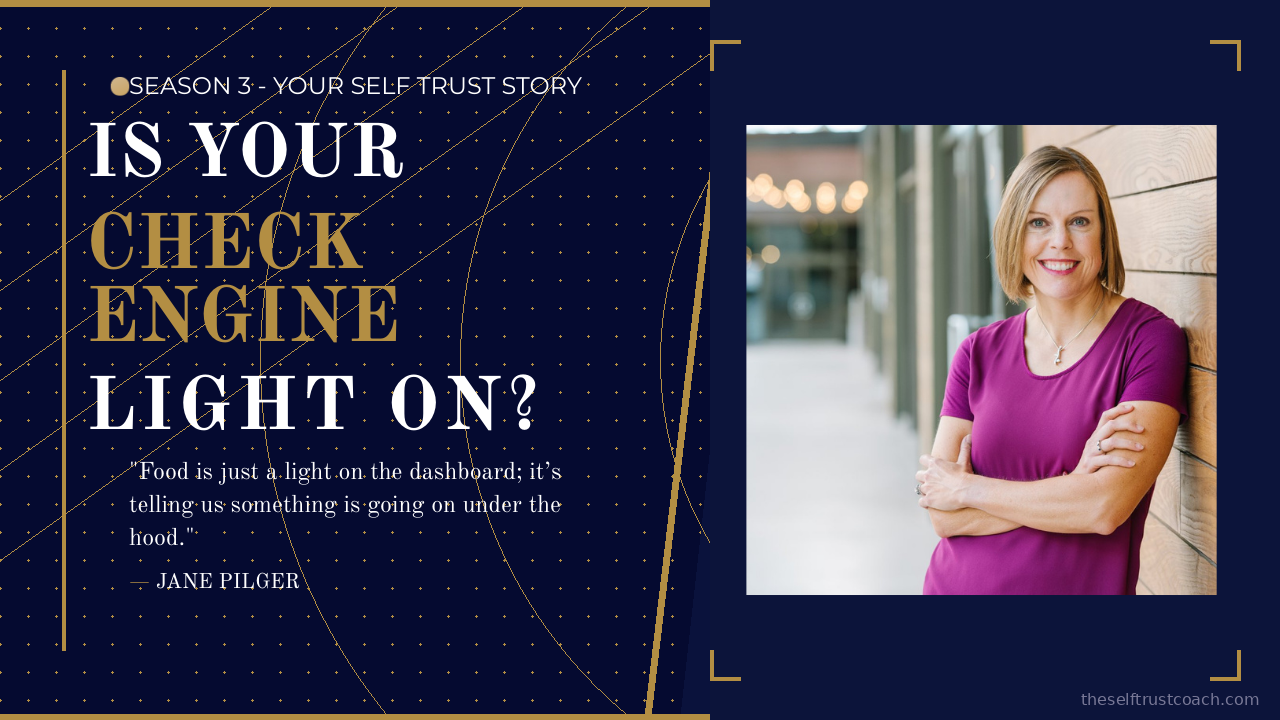
Could vs. Want: The Self-Trust Question That Changes Everything with Jane Pilger
Apr 15, 2026The Self Trust Solution Podcast · Episode 169 · Guest Episode
There's a trap that catches capable people and disguises itself as opportunity.
Someone tells you you'd be great at something. A new project, a new role, a new direction. You have the skills. You've succeeded before. You say yes — because you could. Because you're good at it. Because it made sense on paper.
But just because you could doesn't mean you should. Just because you're good at something doesn't mean it belongs in your life.
Jane Pilger spent 25 years learning this distinction through one of the most intimate laboratories available: her own body's signals. What she discovered changed how she understands self-trust — and how she helps others build it.
Your Body Is Already Telling You the Truth
Jane's work centers on a simple but radical premise: your nervous system keeps a running record of what aligns and what doesn't. Expansion or contraction. Open or defended. At home or off-balance.
Most people have spent their whole lives ignoring those signals in favor of external markers — the should, the could, the what-someone-else-thinks-would-be-a-good-idea. The result is a life built around capability rather than alignment. You succeed at things that leave you hollow, and then wonder why the results don't feel the way you expected them to.
Jane discovered this through her own pattern with binge eating — a behavior she'd been told was the problem, the thing to fix, the failure of willpower and discipline. What she eventually understood was that the behavior was the light on the dashboard. Not the problem. The signal. Her nervous system was telling her clearly: this doesn't feel right. You're not where you actually want to be.
This is what I mean when I talk about the Lobby building its case from external markers. When the Inner Room goes unheard long enough, the body starts speaking louder. The patterns people label as self-sabotage are almost always the nervous system doing its job — pointing at a misalignment that hasn't been addressed.
The Difference Between Could and Want
Jane made a distinction in our conversation that belongs in every entrepreneur's operating vocabulary: her yes is very clear. Her no is subtle. And there's a gray zone — the maybe — where she used to convince herself that yes was possible.
It took her years to realize that gray uncertainty, for her, is actually a no.
This is precision self-trust. Not the dramatic, certain-before-you-act version. The quiet, honest version — learning your own signal system so clearly that you can feel the difference between expansion and contraction, between alignment and obligation, between what you actually want and what just looks good on paper.
The question that changes everything isn't can I do this? It's do I want to do this? Not should I? but is this aligned with what matters to me?
This year Jane set two filters for every decision: Is it simple? Does it light me up? Everything else — the maybes, the convincing herself, the obligation masquerading as opportunity — gets a clear no.
That is Decision Integrity applied at the level of the body. A clean decision made from the clearest internal signal available, not from external pressure or someone else's read on your potential.
What to Do With This
Learn to read your own data. Your nervous system is signaling constantly. Expansion or contraction. Open or defended. The practice is slowing down enough to notice — and then taking that signal seriously rather than overriding it with should and could.
Name your gray zone. For Jane, uncertainty is a no. For you it may be different. The work is learning what your specific signal system is telling you when it's not giving a clear yes. Most people know their yes. Far fewer have examined what their gray zone actually means.
Replace the question. Every time you catch yourself asking can I do this? or should I do this? — replace it with do I want this? and does this align with what matters to me? The first set of questions invites the Lobby to run the evaluation. The second set brings it back to the Inner Room.
Listen to the Full Episode
Jane goes deeper in the episode — including the full story of how a binge eating pattern became the entry point for the most important self-trust work of her life, and how she now helps others decode what their own patterns are actually telling them.
Listen on Apple Podcasts · Spotify
Connect with Jane Pilger:
- If the conversation around food and body signals resonated: Stop Binge Eating Mini-Series
- If you're drawn to the community and inner work Jane described: Gather
If something here resonated — that's data.
Try it right now with one real thought, or go deeper and see what your next level is asking of you.
Want this in your inbox, not just this once?
Weekly insights on real business experiences, real helpful tips, and building a business that holds, sent directly to you.
🔒No spam. Unsubscribe anytime.
Author
