Decision Integrity Coaching: What It Actually Means
Jun 30, 2026A Self-Trust Coach's Guide to Honoring the Decision-Maker, Not Just the Decision
There's a common misunderstanding about what it means to have integrity around your decisions.
Most people think decision integrity means making a choice and sticking with it. Once you've decided, you stay the course. Changing your mind feels like a failure of integrity — proof that you weren't committed, weren't sure, weren't strong enough to hold the line. So people white-knuckle decisions that have stopped serving them, because reversing course feels like it would mean the original decision, and by extension the person who made it, was wrong.
This is not what decision integrity actually means. And the misunderstanding is costing people far more than it's protecting.
What Decision Integrity Actually Is
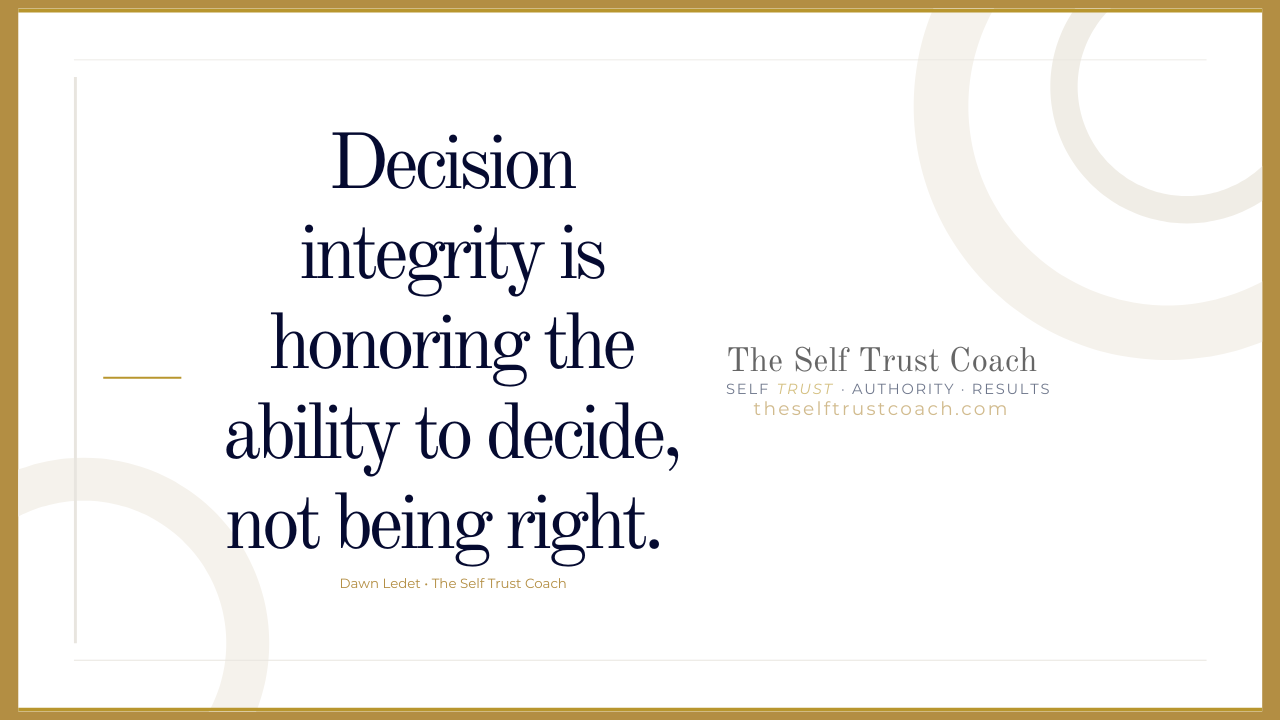
Decision integrity is not about whether the decision was right. It's not about whether you stick with it. It's about honoring your ability to choose — the decision-maker, not just the decision.
Your greatest power is your ability to choose. That power doesn't live in any single decision. It lives in you, as the one who gets to decide, again and again, for the rest of your life. Decision integrity is the practice of honoring that power consistently — regardless of what any individual decision produces.
This means a decision is not a verdict that has to be defended forever. It's a choice made with the information available at the time, which then generates new information through the doing of it. That new information — the result, the data, the lived experience of having made the choice — is exactly what the next decision needs. Sometimes it confirms the original direction. Sometimes it suggests an adjustment. Sometimes it reveals that a complete change of course is the right move.
All three of those outcomes can happen inside full decision integrity. None of them represents a failure of it.
Where the Misconception Comes From
The common version of decision integrity presumes that the information generated by a decision doesn't matter — that the result of a choice shouldn't be allowed to influence whether you continue making that choice. This is treated as commitment. It's actually closer to rigidity.
If integrity meant never changing course, then every decision would have to be made with perfect, complete information from the outset, because there would be no acceptable mechanism for incorporating what you learn after you act. That's not how decisions actually work, and holding yourself to that standard doesn't produce integrity. It produces people who stay in businesses, relationships, and strategies long after the data has made clear that something needs to shift — because they've confused staying the course with having integrity, when what they're actually demonstrating is fear of what changing course would mean about the original choice.
Decision integrity coaching exists to correct this. The decision creates the data needed to make the next best decision. That next decision might mean continuing. It might mean adjusting. It might mean changing course entirely. All three are available, and all three can be chosen with full integrity, because integrity was never located in the permanence of the choice. It's located in your relationship with yourself as someone capable of choosing.
What Breaks Decision Integrity
If staying the course isn't what decision integrity requires, what actually breaks it?
Making yourself wrong.
When a decision doesn't produce the result you wanted, the moment that actually damages decision integrity is the moment you turn the result into a verdict on your judgment, your worth, or your right to keep deciding things for yourself. This is the difference between data and drama. Drama takes a decision that didn't land the way you hoped and uses it as evidence that you can't trust yourself to choose. Data takes the same decision and asks what it's telling you about what to do next.
The decision-maker who berates themselves for a decision that didn't work out is not demonstrating integrity by suffering over it. They're eroding the very thing decision integrity is meant to protect — their own trust in their ability to choose. Every time you make yourself wrong for a decision, you make the next decision harder to make cleanly, because now there's an additional layer of fear attached to choosing at all.
Decision integrity coaching works directly on this pattern. It teaches clinical evaluation of results — what worked, what didn't, what the next move should be — without converting that evaluation into self-judgment. It separates the quality of the decision-making process from the outcome of any single decision, because those are not the same thing and conflating them is what makes people afraid to decide.
The Practice of Decision Integrity
Decision integrity coaching is built on a few core practices:
Owning the choice, not defending the outcome. You made the best decision available to you with the information you had. That's worth owning fully, regardless of what happened next. Owning the choice doesn't require the outcome to validate it.
Treating results as data, not verdicts. Every decision generates information. The work is extracting that information honestly — what this result suggests about the next move — without turning it into evidence about your worth or capability.
Making the next decision from the data, not from fear. When a decision didn't produce what you wanted, the next choice — continue, adjust, or change course — should be made by examining the actual data, not by trying to avoid the discomfort of having been "wrong" about the first one.
Separating the decision-maker from the decision. You are not your decisions. You are the one who makes them. Decision integrity protects that relationship, so the decision-maker stays intact and capable regardless of how any individual decision turns out.
Why This Matters for Follow-Through
Most follow-through problems are actually decision integrity problems in disguise.
When a decision was made cleanly — fully owned, without a back door, without the requirement that the outcome prove it right — follow-through becomes far more natural. There's nothing to relitigate every time discomfort or doubt shows up, because the decision was never contingent on certainty in the first place.
When decision integrity is missing, every decision becomes fragile. The first sign of an unwanted result triggers a full reevaluation of whether the decision was ever valid, which triggers self-doubt, which makes the next decision harder to make cleanly, which produces more inconsistent results, which reinforces the belief that you can't trust your own decisions. This is the loop decision integrity coaching is designed to interrupt.
What Decision Integrity Coaching Looks Like in Practice
A client comes to decision integrity coaching not because they made a wrong decision, but because they're stuck in the aftermath of one that didn't go the way they hoped — paralyzed between staying the course out of stubbornness and abandoning it out of self-doubt, with both options feeling like a referendum on whether they can trust themselves.
The work is showing them a third option that was available the entire time: examine what the decision actually produced, extract the real data, and make the next decision from that data, fully owning whatever it turns out to be. Continue, adjust, or change course. All three are legitimate. None of them is a failure of integrity. The only thing that would be a failure of integrity is refusing to look at the data honestly, or using the data as a weapon against your own ability to choose.
This is the foundation decision integrity coaching builds: a decision-maker who can choose, evaluate, and choose again, indefinitely, without losing trust in their own capacity to do so.
If you want to understand how decision integrity is currently operating in your own decision-making — whether you're honoring the decision-maker or making yourself wrong for results you didn't choose — the Self-Trust Identity Map will show you something specific. Free, three minutes.
Ready to go deeper? Here's what Claimed is and who it's for.
If something here resonated — that's data.
Try it right now with one real thought, or go deeper and see what your next level is asking of you.
Want this in your inbox, not just this once?
Weekly insights on real business experiences, real helpful tips, and building a business that holds, sent directly to you.
🔒No spam. Unsubscribe anytime.
Author
