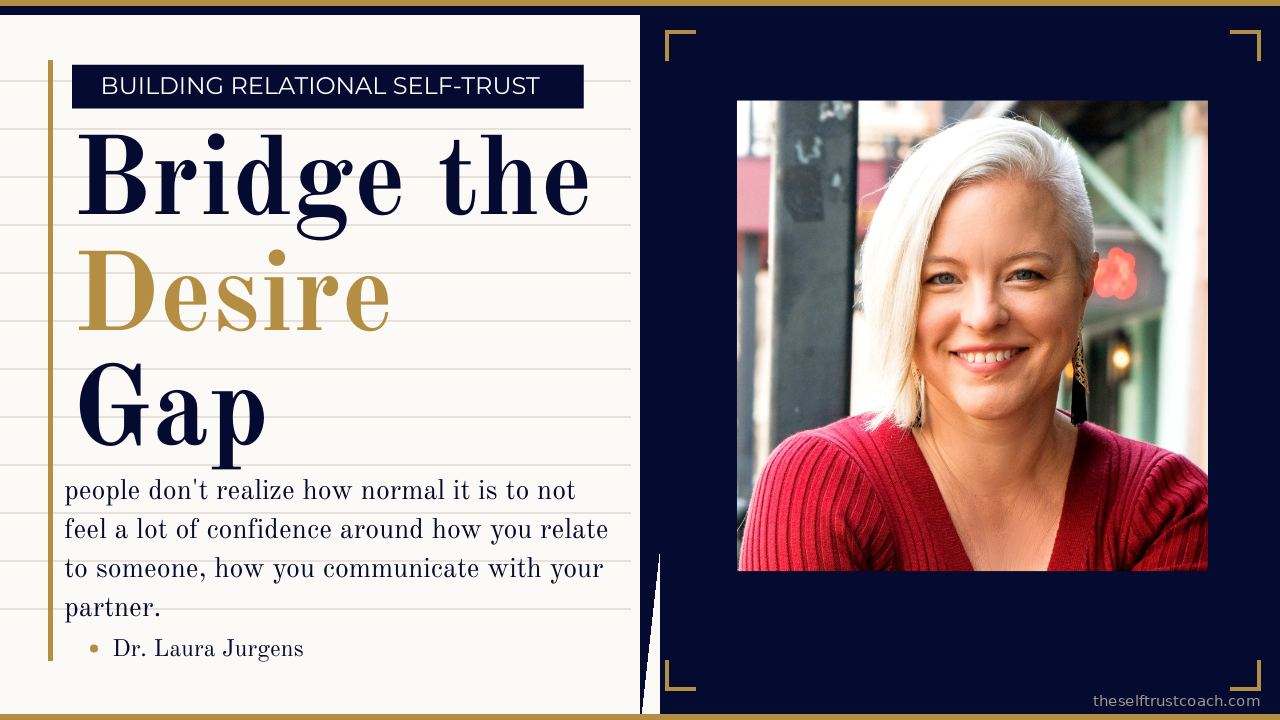
Why High Achievers Struggle with Intimacy — and How Self-Trust Fixes It with Laura Jurgens
Apr 22, 2026The Self Trust Solution Podcast · Episode 170 · Guest Episode
Here's what nobody tells you about self-trust: you probably already have it. Just not everywhere.
You might have enormous self-trust in your professional domain — your ability to solve problems, deliver results, lead with clarity. And almost none in your intimate relationships. Or in your body. Or in your capacity to run a business after years of succeeding inside institutional structures.
This isn't a character flaw. It's a compartment. And Laura Jurgens spent years learning how to build evidence in the ones that were empty.
The Identity Gap Looks Like Compartmentalization
Laura's story is one of the most precise illustrations of the Identity Gap I've encountered.
She was homeless as a teenager. She pulled herself through university. She earned a PhD and became a tenured professor at a top research university. By every measurable standard, she had overcome extraordinary odds and built an undeniable track record of success.
And she had zero self-trust in her ability to run a business.
Not because she lacked capacity. Because she lacked a specific kind of proof. Laura had built her evidence inside institutional scaffolding — school, academia, research. All established systems with clear structures and defined pathways. The moment she stepped outside that structure to build something of her own, the self-trust evaporated.
This is the Identity Gap operating in a specific compartment. The gap between who you think you are — someone who succeeds inside systems — and who you really are — someone whose capacity extends far beyond those systems into territory you haven't yet proved to yourself.
The question she was facing isn't unique to her. It shows up for coaches and entrepreneurs constantly: I know I can do the work. But can I run a business around it? Can I market it? Can I trust myself to build something without the scaffolding?
These are different questions than the ones already answered. And they require different evidence.
Building Evidence Deliberately
What Laura did next is the Momentum Loop applied with precision: Decide → Do → Have Your Own Back.
She made a clean decision — she was going to leave academia and become a full-time coach. She didn't have the evidence yet. She made the decision anyway, because she understood that the evidence doesn't arrive before the decision. It arrives because of it.
Then she structured the doing in a way her nervous system could survive. She kept her job while building the business on the side. She gave herself 400 hours of free coaching to prove to herself — not to the market, not to anyone else — that she could actually help people. She gathered real data through real action with real people.
Then she evaluated honestly. When the evidence started accumulating — clients getting results, sessions landing, the work actually working — she looked at it clinically. Not with drama, not with the Lobby's verdict of it still might not be enough. With honest examination. This is working. I'm learning. This is sustainable.
This is what Have Your Own Back looks like in the context of building evidence. Not manufactured confidence. Not positive thinking layered over unresolved doubt. Real data gathered through real action, evaluated honestly, used to update the self-concept in a specific compartment where it was lagging.
Her nervous system stayed terrified right up until she left her job. She left anyway — because the decision wasn't being made by the fear. It was being made by the evidence she'd built in spite of it.
Where High Achievers Get Stuck with Intimacy
Laura now helps clients with desire gaps and relationship intimacy — which turns out to be exactly the same pattern operating in a different domain.
Someone might be a powerful decision-maker professionally. They lead teams, deliver results, operate with clarity in complex environments. And in their intimate relationships, they feel like a complete beginner. They don't trust themselves to navigate desire, conflict, vulnerability, or closeness. The confidence that feels so natural at work evaporates the moment they need to be known rather than capable.
Same mechanism. Different compartment.
The reason high achievers specifically struggle here is precisely because of the evidence they've built. They know how to succeed in domains that reward competence, output, and measurable results. Intimacy doesn't work that way. It rewards presence, vulnerability, and a willingness to not know — which are the exact opposites of the skills that produced the professional track record.
The Lobby — wired to protect using the evidence it already has — generates enormous resistance in the unfamiliar domain. You don't know how to do this. You've never had evidence here. What if you fail at this too? And because there's no existing track record to point to, the resistance feels more authoritative than it actually is.
The Inner Room knows something different: the capacity is there. The willingness is there. What's missing is evidence built through practice in this specific domain.
What to Do With This
Identify the compartment. Where specifically is your self-trust weak? Not in general — in the precise domain where the evidence is thin. Relationships. Business systems. Visibility. Intimacy. Naming the compartment is the first move.
Build evidence deliberately. Self-trust in domain X is built through action in domain X. Not through thinking about it, not through reading about it, not through waiting until you feel ready. Through structured action that generates real data. Laura's 400 hours of free coaching is the model — she didn't wait to feel confident. She built the evidence that produced the confidence.
Evaluate clinically, not dramatically. When the evidence starts accumulating, look at it honestly. Data not drama. What is this result actually telling you about what to do next? Not what does it say about whether you're allowed to keep going — what does it tell you about the next move?
Let the nervous system catch up on its own timeline. The fear doesn't have to leave before you act. Laura's nervous system was terrified right up until she left. She left anyway. The self-trust doesn't require the absence of fear — it requires the decision to not let fear make the decision.
Listen to the Full Episode
Laura goes deeper in the episode — including the full story of her transition from academia to coaching, how she helps clients build evidence in the intimate domains where high achievers struggle most, and what self-trust looks like when it's been built compartment by compartment through real action.
Listen on Apple Podcasts · Spotify
Connect with Laura Jurgens: laurajurgens.com
If something here resonated — that's data.
Try it right now with one real thought, or go deeper and see what your next level is asking of you.
Want this in your inbox, not just this once?
Weekly insights on real business experiences, real helpful tips, and building a business that holds, sent directly to you.
🔒No spam. Unsubscribe anytime.
Author
