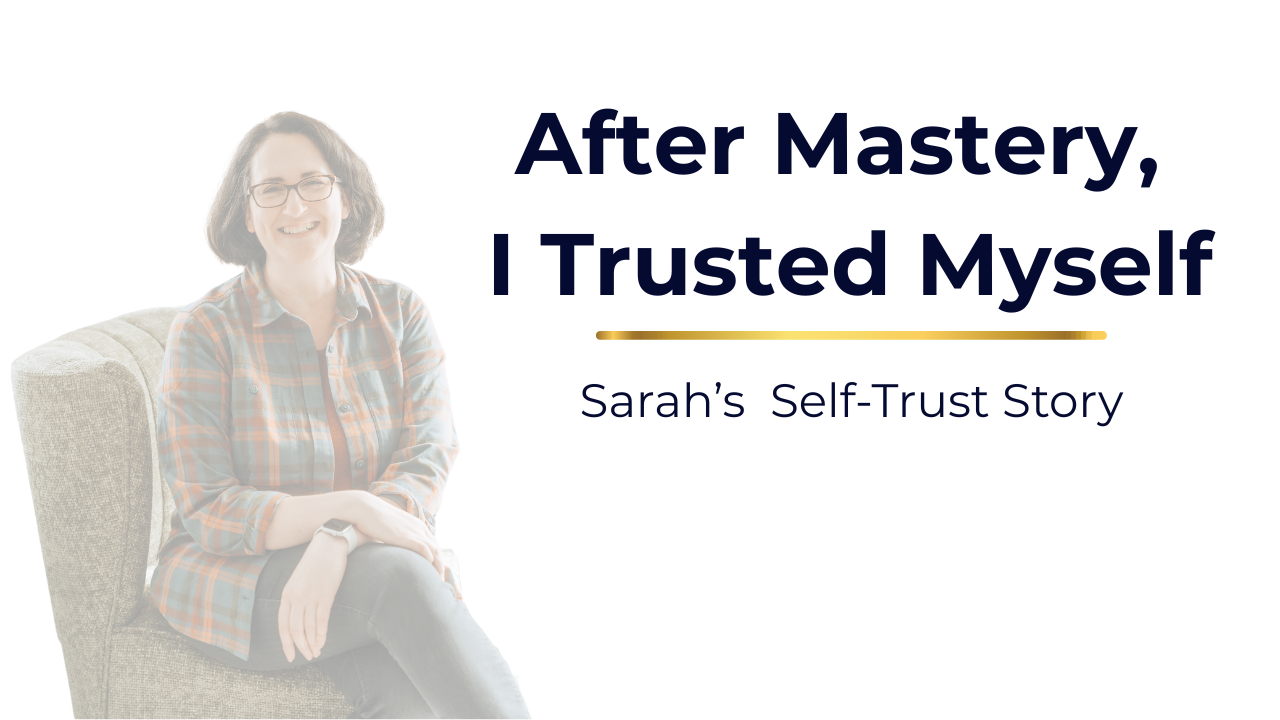
After Mastery, Trusting Yourself Again | Sarah G on Self-Trust
Mar 24, 2026The Self Trust Solution Podcast · Season 3
There's a particular kind of self-trust challenge that doesn't get talked about enough — the one that arrives not at the beginning, when you're trying to prove yourself, but after. After you've built something real. After the competence is established. After you've already done it once and know you can.
That's when a different question shows up: what if what I've mastered is no longer where I'm meant to stay?
That's the question UX designer turned copywriter turned productized website builder Sarah Guilliot — known as Sarah G — has been navigating for the past few years. Her career spans more than two decades of UX design work for global brands, a decade of entrepreneurship, a pivot to copywriting that worked, and now another pivot back toward design — but from a completely different place.
Her story isn't about starting over. It's about what it looks like when experience compounds, and how self-trust operates at the intersection of identity and evolution.
The catalyst that started everything
Sarah's path into entrepreneurship wasn't strategic. It was personal.
After twenty years in corporate — doing what was expected, following the path, setting aside the quiet dreams she hadn't yet given permission to pursue — her husband had a stroke. He's fully recovered now, she's quick to say. But that event cracked something open.
It made her go inward. And going inward, she says, was the very beginning of understanding self-trust.
What I notice in that part of her story is how often the first real encounter with self-trust isn't the result of a mindset shift or a coaching program. It's the result of a moment that makes the cost of not trusting yourself suddenly visible. The dreams don't become louder. The reasons to delay just become unbearable.
The pivot that felt scary — and then didn't
Two years ago, at an annual mastermind retreat, Sarah had a quiet recognition: she wanted to let go of design and focus entirely on copywriting.
Quiet, but not small. Her entire professional identity had been wrapped in design for over a decade. I'm a designer was how she answered the question "what do you do?" — even though copywriting had been part of her work all along.
What she did next is worth paying attention to. She didn't build a new website. She didn't get certified. She didn't redesign her brand or wait until she had a complete plan.
She reached out to the people she knew and said: I'm doing this new thing. Do you need help?
That's it. The decision, made. The action, minimal. The complications, left off.
And it worked quickly. She hit minimum viable income fast. The momentum built like dominoes.
What she said about that experience has stayed with me: when I leaned into self-trust and just decided to go for it, everything felt fluid after that. Not because the doubt disappeared — she's clear that it didn't. But because she stopped requiring the doubt to resolve before she moved.
The second pivot — and the fear of looking flaky
Here's where Sarah's story gets particularly useful.
After two years of successful copywriting work, another nudge arrived. She came across a productized service model — something she'd always wanted to create but could never figure out how to build. The opportunity was to go back to websites. Back to design. Back to something that looked, from the outside, like a retreat.
And she felt it: are people going to think I'm flaky? Again, Sarah. Can't you make up your mind?
That question is worth naming precisely because of what it actually is. When we worry about what other people will think, we're almost always really asking what we think of ourselves. The external audience is a projection. The real trial is internal.
What Sarah did with that question is the move: she answered it. Not by dismissing it, not by fighting it — by actually looking at the data. Everything from corporate, everything from eight years of agency work, everything from two years of copywriting — none of it was wasted. It was all compounding. The thing she was building now would be the best version it could be precisely because of everything that came before it.
That's not a pivot back. That's experience arriving at the place it was always building toward.
What self-trust looks like when you're not yet smooth
Sarah is in early stages with her new productized model. She has her first clients. She's developing her SOPs. And she's honest about the fact that it's not going to be perfectly smooth at the beginning.
What she's doing with that — the way she's holding it — is worth naming:
She's reminding herself daily that she knows how to do this. That anything that comes up she can figure out. That she has support. That nothing is a failure. That the result her clients will get is going to be what they came for, whatever the timeline takes.
That's not toxic positivity. That's not pretending the nervousness isn't there. That's the Inner Room staying steady while the work gets figured out — refusing to let the early friction become a verdict on whether this was the right move.
On experimentation as a frame
When I asked Sarah what she'd suggest to someone stuck between chapters, her answer was immediate: think of your next move as an experiment.
Not as the thing you have to do forever. Not as the thing that must succeed or else. As a hypothesis. Something you're going to try, gather data from, and adjust.
She put it in language I loved: instead of all or nothing, find the and. If there's an all over here and a nothing over there, what's in the glorious middle? What are all the options that live in between the binary?
That's exactly the frame that makes the Momentum Loop actually usable. Decide → Do → Have Your Own Back works when a result is data. It breaks down when a result is a verdict. The experiment frame keeps the result where it belongs — as information pointing toward the next decision.
What she'd tell her earlier self
When I asked Sarah what she wished her earlier self had known, sitting at that retreat two years ago wrestling with the design-to-copywriting question, she said this:
You really do have everything you need. You don't need to search for an answer outside of yourself.
She laughed a little when she said it — because she knew she'd heard that before and hadn't quite believed it. There are proven models out there. There are people with answers. Why trust yourself when you can just follow what works?
But the answer she's arrived at is the one I come back to again and again with every client: tune in first. Find out what you need, what you already know, what your particular situation is asking for. Then go find the support to fill the specific gaps. Not the other way around.
Every strategy that exists works for someone. It doesn't work for everyone. Knowing which ones work for you, in your way of working, toward what you're actually building — that requires going inward first.
Listen to the full episode
Sarah's complete story — including how her husband's stroke became a catalyst for trusting herself, the specific way she structured her pivot to copywriting, and how she's building her productized design service for coaches — is all in the episode.
Listen on Apple Podcasts · Spotify · YouTube
Connect with Sarah G: Website: sarahdesign.com Special page for Self Trust Solution listeners: sarahdesign.com/self-trust Instagram: @sarahdesignagency
If Sarah's story is landing — if you're in between chapters and wondering whether the next move is a step back or a step forward — the Self-Trust Identity Map is a good place to get clear on where you actually are. Free, about three minutes.
Ready to go deeper? Here's your next step.
If something here resonated — that's data.
Try it right now with one real thought, or go deeper and see what your next level is asking of you.
Want this in your inbox, not just this once?
Weekly insights on identity, self-trust, and building a business that holds, sent directly to you.
🔒No spam. Unsubscribe anytime.
Author
