Almost There — and Why Almost Keeps Moving
Apr 27, 2026Almost there.
You've been almost there for a while now. You can feel it — the next version of the business, the next level of income, the next stage of impact. It's not a fantasy. It's specific. You can describe it. You can see what it looks like and feel what it would mean.
And you're almost there.
Almost making the income that would make it feel real. Almost fully committed — but there's still a part of you holding something back, waiting for a sign that it's safe to go all in. Almost trusting yourself enough to make the bold move, charge the right price, say the thing you actually believe instead of the version you've softened for the market.
The vision hasn't changed. The almost has just kept pace with it.
Every time you get close — a good month, a client who says yes, a piece of content that lands the way you hoped — the almost moves just far enough ahead to stay out of reach. The milestone that was supposed to make it feel real arrives and somehow it doesn't quite land the way you thought it would. So you set your sights on the next one. And the almost moves again.
This is not ambition. Ambition is generative — it builds on what's been accomplished and reaches forward from a stable place. What this is, is something different. It's a loop. And the loop has a mechanism underneath it worth understanding.
Why Almost Keeps Moving
The almost doesn't move because you're failing. It moves because of what you're using it for.
Almost is the distance between where your results are and where your self-concept is still operating from. And the self-concept doesn't update automatically when the results arrive. It updates when you decide it does.
Here's what that looks like in practice:
The good month arrives. The Lobby — that reactive internal space where every result gets filtered through fear and self-judgment — processes it and concludes: one good month doesn't prove anything. Let's see if it holds. So the good month becomes a data point that needs confirmation rather than evidence of who you already are.
The client says yes. The Lobby processes it: this one client doesn't mean the business is working. You need more before you can believe it's real. So the yes becomes a conditional — one that will matter once it's repeated enough times to count as proof.
The content lands. The Lobby processes it: people liked it, but did it convert? Did it create the result that would make it meaningful? So even the thing that worked gets filed under not quite enough yet.
This is how almost keeps moving. Not because the results aren't arriving — they are. But because the self-concept is running an earlier operating system that requires more proof than any single result can provide. And since the proof requirement keeps shifting, the almost keeps pace.
The target moves because you're using the results to try to settle something that results were never designed to settle.
What You're Actually Waiting For
Underneath the almost is a specific question that's been running on a loop: when will I have enough evidence to believe I can have what I want?
The answer the Lobby keeps generating is: not yet. A little more. Almost.
And the cruel logic of that loop is this — the more you accomplish, the higher the bar moves. Because the bar was never about the results. It was about permission. And permission is what you've been waiting for external results to deliver.
The revenue milestone that was supposed to make it feel real. The number of clients that would prove the business is working. The content performance that would confirm you're saying the right things to the right people. The moment when enough evidence has accumulated that you finally feel allowed to claim the life and business you want.
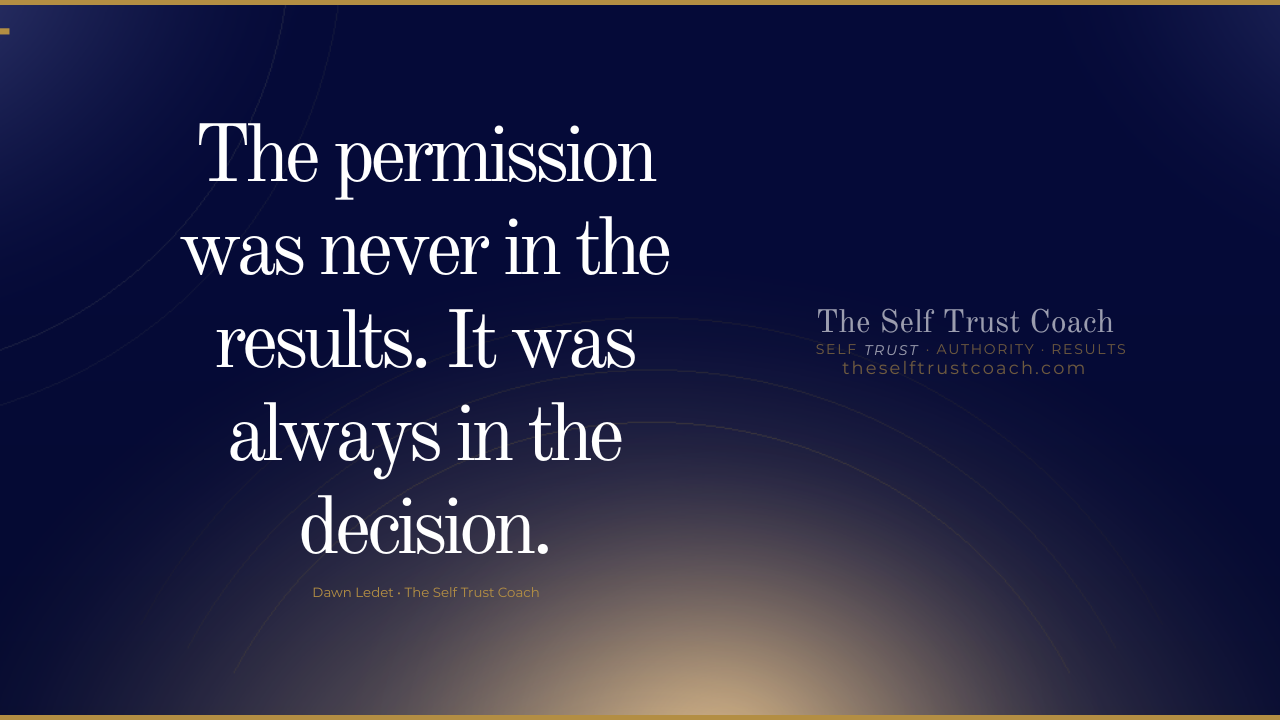
That moment doesn't arrive through results. Not because you're not capable of creating the results — you are, and you have been. But because the permission was never in the results. It was always in the decision.
Self-trust is not built through results. It's chosen before them. And then the results become expressions of that choice rather than verdicts on whether the choice was right.
Almost is what happens when you're waiting for the results to make the choice for you.
The Moment Almost Becomes Claimed
There's a specific shift that happens when the almost tips.
It doesn't usually happen dramatically. It's not a lightning bolt moment of sudden confidence or a result so undeniable that the Lobby finally goes quiet. It's quieter than that. It's a recognition — often in a moment of stillness — that the answer isn't out there. That the next strategy isn't the one. That the variable you haven't examined is yourself.
And then a decision. Not to feel differently. Not to wait for certainty. Not to accumulate more evidence before moving. A decision to claim — the identity, the authority, the vision — from where you actually are right now, with what you actually have, as who you actually already are.
The almost doesn't disappear. The Lobby doesn't go silent. The results don't instantly match the vision. But something underneath stabilizes. The reaching stops. The operating system updates. And the business that gets built from that place has a different quality — more precise, more distinctly yours, more sustainable — because it's coming from claimed authority rather than from the attempt to earn it.
Claimed isn't a destination you arrive at when the results are finally right.
It's a decision you make before they are.
If you recognize yourself in the almost — if the vision is clear and you've been almost there for longer than makes sense — the Self-Trust Identity Map will show you something specific about where your self-concept is currently operating from. Free, three minutes.
If you already know the answer isn't in another strategy — here's what Claimed is and who it's for.
If something here resonated — that's data.
Try it right now with one real thought, or go deeper and see what your next level is asking of you.
Want this in your inbox, not just this once?
Weekly insights on identity, self-trust, and building a business that holds, sent directly to you.
🔒No spam. Unsubscribe anytime.
Author
