Your Content Is Good. So Why Aren't the Results Matching?
Apr 20, 2026You know your content is good.
Not in an arrogant way — in a quiet, honest way. You read it back and it sounds right. It sounds like you. It says the thing you actually mean, in the way you actually mean it. You get comments that confirm it. People tell you it resonates. Occasionally someone messages you to say it changed something for them.
And then you look at the results — the clients, the revenue, the momentum — and they don't match.
So you do what any logical person does. You look for the variable that's off.
Maybe it's the niche. Too broad, too narrow, not specific enough about who you serve. You refine it. You get more specific. You change the language around who you're for.
The results still don't match.
Maybe it's the messaging. The way you're describing the problem, the transformation, the offer. You study what's working for people who are getting results. You adjust your language to match theirs. You model the framing that seems to be landing for others.
The results still don't match.
Maybe it's the strategy. The platform, the frequency, the funnel, the offer structure. You make changes. You try what's working in your industry. You follow the advice of people whose results you want.
The results still don't match.
And somewhere in this cycle, you arrive at a conclusion that feels both logical and exhausting: there must be something I'm missing. Something external. Something strategic. Something that other people have figured out that you haven't yet.
Here's what I want to offer you — not as comfort, but as diagnosis:
The content isn't the problem. The strategy isn't the problem. The niche isn't the problem.
The problem is the belief underneath every change you've been making.
The Belief You Don't Know You Have
When your content is good and your results don't match, the mind goes looking for a logical explanation. And the logical explanation is almost always external — because the actual variable is invisible.
The actual variable is this: you are operating from the belief that you don't have the authority yet.
Not consciously. You wouldn't say that if someone asked you. But it's running underneath every decision you make about your business. It's why the content that sounds like you still gets softened before you post it. It's why you look at what's working for someone else and wonder if their approach is the missing piece. It's why the results feel like a verdict rather than data.
When that belief is the operating system, every move you make is an attempt to earn what you think is missing. And here's the cruel logic of that loop: every time you earn something — a good comment, a new follower, a client who says yes — the belief doesn't update. Because earned authority is always provisional. It can always be taken back by the next result that doesn't match.
This is why the niche change doesn't fix it. The messaging refinement doesn't fix it. The strategy adjustment doesn't fix it. You're solving a visible problem — the content, the platform, the offer — when the actual problem is invisible. It's the belief that the authority has to be earned before it can be expressed.
What Copying Others Is Actually Telling You
When you study what's working for someone else and adapt it to your business, you're not doing something wrong. You're being logical. You're looking at evidence and drawing a conclusion.
But there's something worth examining underneath that impulse.
When you look at someone else's results and think if I do what they're doing, I'll get what they're getting — what you're actually believing is that their results prove something about their approach that your results are disproving about yours. You're treating their success as evidence that their way is right and your way is missing something.
What it's actually telling you is that you don't yet trust your own way enough to claim it fully.
Not because your way is wrong. Because you're operating from the belief that the authority to do it your way has to be validated by results first — and results keep arriving as evidence that the validation isn't here yet.
This is the almost. The space between who you think you are — someone who is almost there, almost ready, almost proven enough — and who you actually are. Someone who already has the authority. Someone whose content is already good. Someone who has been doing the work, building the knowledge, developing the capacity for years.
The gap isn't in the content. It's in how you see yourself.
The Thing That Actually Moves the Needle
There's a specific shift that happens when coaches and experts stop trying to earn their authority and start claiming it.
The content doesn't change dramatically. The platform doesn't change. The niche doesn't change. What changes is the quality of certainty underneath everything. The content that used to be softened before posting gets posted as written. The offer that used to be framed as a question gets framed as an invitation. The position that used to be hedged gets held.
And people feel the difference.
Not because claimed authority is louder or more confident in a performed way. Because it's specific. It's precise. It's unmistakably one person's perspective, arrived at through one person's particular body of experience and knowledge. You can't copy it because it comes from the inside out.
That's what your content is already trying to be. That's why it sounds like you when you read it back. That's why people tell you it resonates.
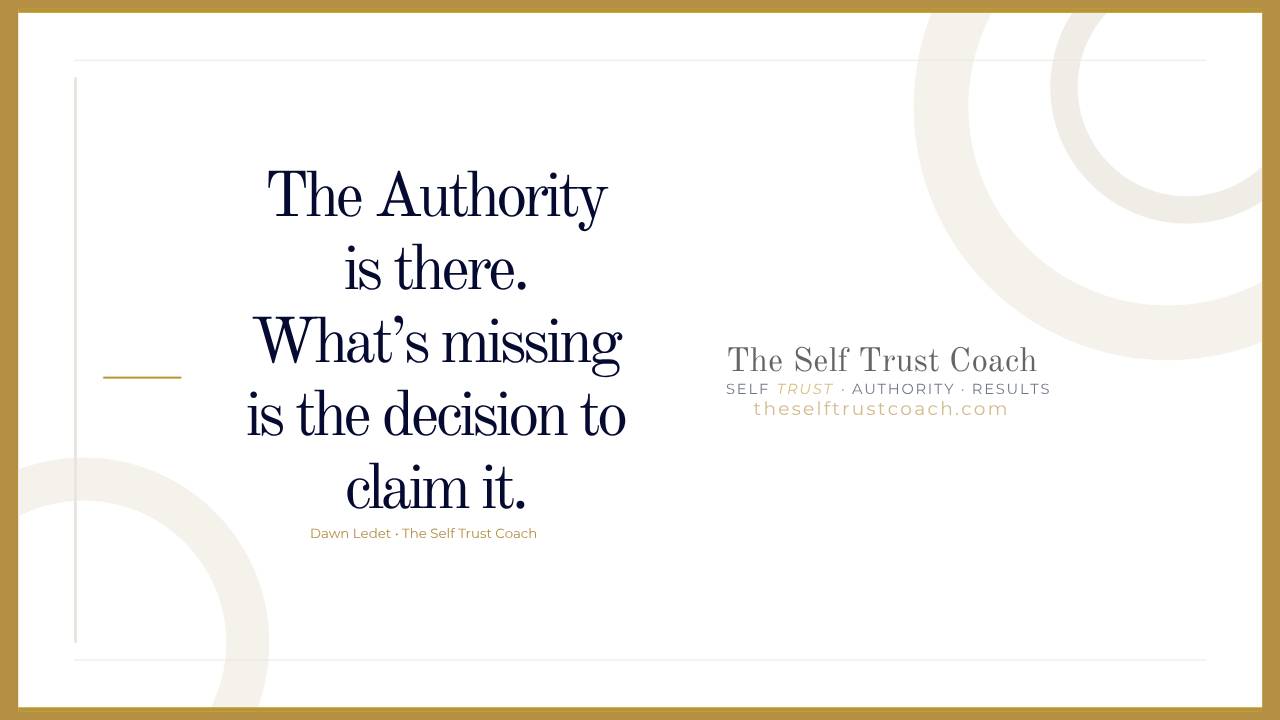
The content is already there. The authority is already there.
What's missing is the decision to claim it — not as something you've earned through the right results, but as something that was always yours to operate from.
That decision doesn't require a strategy change. It doesn't require a new niche. It doesn't require waiting for the results to finally match before you believe you're allowed to have them.
It requires seeing yourself clearly enough to lead from who you already are.
If you recognize yourself in this — if your content is good and the results aren't matching and you've been looking for the external variable — the Self-Trust Identity Map will show you something specific about where you're actually operating from. Free, three minutes.
If you already know the answer isn't in another strategy change — here's what Claimed is and who it's for.
If something here resonated — that's data.
Try it right now with one real thought, or go deeper and see what your next level is asking of you.
Want this in your inbox, not just this once?
Weekly insights on real business experiences, real helpful tips, and building a business that holds, sent directly to you.
🔒No spam. Unsubscribe anytime.
Author
